Showing posts with label scifimagpie. Show all posts

Tuesday, August 19, 2014

Guest Post by Michelle Browne (SciFiMagpie)--Continuity: The Devils Are in the Details

Hello hello!

A big and very gracious thank-you to the SFRB for letting me guest-post once again today. Today's post has been inspired by a bugbear I've been dealing with lately: continuity.

Those of you who are fans and bloggers might shrug when I mention continuity. Writers, on the other hand, are probably feeling a shiver down their spines that has nothing to do with the ice-bucket challenge. To explain why this induces muttering dreams and sleepless nights, it wouldn't hurt to have a definition.


Source. Pictured: a reader unhappy with continuity errors.

Continuity: what is it, and why does it matter?


"Continuity" refers to self-consistency through descriptions, action, storylines, and development in a creative work. In a nutshell, good continuity means adhering to your own rules. A work should be congruent and not vary too much throughout its existence. "Discontinuity" happens when errors are made or the lore is changed; "retroactive continuity", or "retcons", are made to reconcile early errors with later events, details, or changes. You can also manipulate continuity in order to make the narrator unreliable. Inception, American Psycho, Memento, and other films and books have made use of this. An unreliable narrator is great when it's done on purpose, but inconsistent details can also make a writer look sloppy.

 For instance, your distraught loner character might develop into a compassionate and friendly, even optimistic person through a series, but she probably shouldn't too perky and resilient right away if she's recently lost her entire family, dog, boyfriend, and ship in a single fell swoop. This usually happens when a series has been left alone for too long and the author's forgotten how to write for a character, or when the author is getting bored of a character's traits.


Character continuity is important, and the same goes for plot details. Something that one character says happened two years ago should not suddenly have happened ten years ago when it's mentioned again. We'll go deeper in a second.


Why is this important for sci fi? 


Everyone knows about the fan outcry that happened when George Lucas created the first Star Wars movies, but retroactive continuity issues also played a role in the first trilogy. Entire blogs have been written and based on examining errors in the series, so let's talk about a different example--Doctor Who. With so many writers, the story of the Time War has been bent and twisted and changed in ways that can seem self-contradictory. This also affects the characters and their journey, of course, because the plot never functions in isolation. (If it does, get an editor to look over your book, stat, because something is broken.)

As writers of fiction, it's important to learn from failures and make sure that our worlds are consistent. A tiny detail that was mentioned and thrown away earlier can be mined for plot purposes later, or, conversely, can break the plot. Farscape had a wonderful episode called "The Locket", but the mechanism their ship Moya used to escape a time-freezing zone, a "reverse starburst", unfortunately was never mentioned again. The eagles in The Lord of the Rings or the many, many plot devices used in the Harry Potter series are examples of dropped plot devices and throwaway details that accumulated to create some improbable and silly situations for the characters. The worst case I've seen was probably in The Sword of Truth--there were so many throwaway plot devices in this series that the author had to go nuclear on the ending for the last book in order to reconcile them all.

When plot devices are forgotten or tossed aside from continuity, characters' situations can end seem silly to the audience. Just because the author has forgotten something doesn't mean our readers will, unfortunately!


Source. 


How do we fix it?


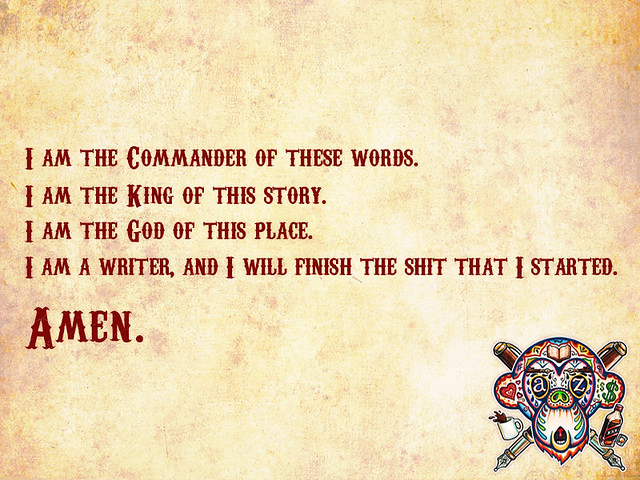
It wouldn't be a SciFiMagpie post without a solution. In this case, it's simple, but a lot of work: KNOW THY WORLD. Chuck Wendig has a particularly wonderful affirmation card (posted above). The way I'm coping with continuity in The Meaning Wars is by re-reading And the Stars Will Sing and The Stolen: Two Short Stories.  Unfortunately, it's also brought a few flaws and typos in the books to my attention, but that's part of the process. You can't be a better writer unless you know your flaws.

"How can I smooth over that exposition? How can I change things so I can avoid that head-jump--can I imply things, perhaps? Maybe do a short scene from the other character's perspective? Did I just change the location of this world by accident? How can a luxurious Southern California/Ireland-like region exist in a warzone? Should I move it?" These are just a few of the questions I've been asking myself, and while painful, it's also really satisfying to know when I've gotten something right. After all, readers love to niggle, but even the ones who miss continuity errors appreciate smooth, consistent stories. This is also the reason why editors are very, very useful people to know.


And the better you do at maintaining continuity, the less sleep you'll lose at night after you accidentally change a character's name, make them three inches taller than they were in the first book, and give them a peanut allergy that would have killed them in the first scene in the second book.

*****
Thanks for dropping by the nest once again. Don't miss any of the phuquerie. Find Michelle on TwitterFacebook, and on Tumblr, and find her work on Amazon. Check back on the blog to see when one of the irregular posts has careened onto your feed. This is the one and only SciFiMagpie, over and out! 

Tuesday, June 3, 2014

Technowank vs. Character Drama: Which One is King?

Hello hello!

So, along with the massive inequality issues heating up the field, a new subgenre of sci fi has emerged to stir the pot further. Meet science fiction romance, or sci-fi romance: it's exactly what it sounds like. And honestly, it's the only kind of romance I can read, on the rare occasions that I do read romance.

 If you think about it, it was a natural progression. It's not like we haven't had a history of romance in sci fi before. Ursula Le Guin, Orwell, and Zamyetin all had romance in their books. In We, the first dystopian book, the romance drives the plot--as it does in 1984. And do we need to mention the frequent romances in television?  Movies aren't short on it either. "I love you. I know." Of course, Farscape has a fantastic romance--more than one of them--and Doctor Who has, too. The Trek was never short on romances either. So why are people compulsively vomiting and complaining about icky girl germs with sci-fi romance?


I don't like romance.


Well, okay, that's not entirely true. I like love stories a lot. I like a bit of bittersweetness or tragedy in there, too, because I think it's more interesting, but there's no getting away from the fact that I didn't cry my way though The Fault in Our Stars just because of kids with cancer. And I edit a lot of romances, and sometimes, I do really enjoy them. A good human story is always appealing, and that's where the hook comes from, for me at least. Other people like the escapism and the heady feelings and the 'happily ever after' thing, and I can't complain about those, really. But for some reason, female-coded escapism (romance, etc, etc) is seen as 'worse' or 'icky' compared to male-coded escapism, such as technowank and space ships and that sort of thing.


A brief digression on technowank


I also don't have a ton of patience for books where the author inserts a technical manual in the middle of the action. I've ranted and raved about exposition dumps on many occasions, and so I'll try to keep this short.
As much as I like sci fi, the hard stuff can turn into a very technical description of nuts and bolts and can actually lose sight of the plot. Some people love it when authors get carried away, others fall asleep.

Robots are awesome, but what makes them interesting is all the transhumanist arguments and the 'where does humanity lie', ghost in the machine stuff. It's not about the titano-carboridium alloys. We don't like C-3P0 because of his blank expression or the six thousand known languages in his database, we like him because he flies off the handle and acts as straight man to R2D2. Moya is a great ship, but as much fun as it is to run around her corridors with Dutch-angled camera work, it's the stuff that happens on her and to her that keeps our attention.


Shiny is good. 


I think visual formats do have an easier time of it because they can get away with just showing, rather than telling us too much--the 'show/tell' thing can be a bit tricky when it comes to the description end of things. We do need to know what things look like and have some idea of how they work, but finding the balance can be hard. And there is room for those lovely sweeping descriptions of xeno panoramas, big shiny ships, and all that good stuff. And, yeah, I rarely tire of reading about a well-written, gritty spaceport and the delicious food in it. One of the things I loved about the short Star Wars anthologies that came out was that they described Tatooine and the new Jedi Academy in fine detail. It was nice to hear about the little things and the students' person effects and the bacta tanks and 'shimmersilk' robes of dignitaries. The 'shiny' stuff and the worldbuilding are fun for both readers and writers.


Why do we need to fuss about characters?


Now that you know I'm not an opponent of worldbuilding or lyrical digressions, listen carefully when I say: it's all worthless with crappy characters. I've seen it mentioned in a few writing guides, and it's true--characters are what a reader remembers. Sure, Giger is amazing and the alien is gorgeous, but we remember Ripley and Ash and even that cat. That's why Prometheus sucked compared to Alien (s). It's also why many fans bemoan the Dune sequels and Star Wars prequels--all the king's gorgeous visuals and all the king's men couldn't make up for weird, constrained acting from most of the performers and characters that most of us just didn't like. (Phantom Menace, apart from the horrible racist caricatures, was the strongest of the three because it had the best portrayals of the characters, and I will fight you on that.)  The classics of sci fi have endured because they have fantastic human stories, not because of their settings alone. Sure, settings spark the imagination, but it's the people we relate to, cheer for, scream at, and develop messy childish crushes on that keep us going.


So, what does this have to do with sci fi romance again?


Well, sci-fi romance is ultimately only as strong as its characters. It's why diversity is so important in media, and it's why those of us defending that get pretty up in arms about it. Some sci fi romance is probably not that well-written, but the same is true of the 'old-fashioned', 'traditional' technowank stuff that relies on shiny bits rather than character development. Ultimately, one or two or even ten bad books do not merit discarding an entire genre. Sci-fi romance needs a little more time to grow up and branch out, sure, but it's a very new subgenre. Ultimately, the potential of more explicitly character-driven sci-fi is really exciting. We can take the settings and the shiny stuff for granted, because sci-fi is established as a genre. It knows what its doing now.We don't have to set up and describe every damn space ship because readers know what they are. That means we can push some boundaries. And ultimately, pushing boundaries while we envision the future is the heart of gold that drives this genre forward.


*****
Thanks for dropping by the nest once again. Don't miss any of the phuquerie. Find Michelle on TwitterFacebook, and on Tumblr, and find her work on Amazon. Check back on the blog to see when one of the irregular posts has careened onto your feed. This is the one and only SciFiMagpie, over and out! 

SFR Brigade Bases of Operation