
By Arlene Webb
 Nick DiChario’ short stories have appeared in many magazines and anthologies including The Year’s Best Science Fiction, The Year’s Best Fantasy and Horror, and The Best Alternate History Stories of the 20th Century. Nominated for two Hugo Awards and a World Fantasy Award, the list of credentials is quite long, so please check out his website at http://www.nickdichario.com/ for the fuller picture.
http://nickydthewriter.wordpress.com/
What were your early influences in writing? Any mentor you wish to mention?
When I started writing science fiction way back in the 1980s, I took a writers' workshop at SUNY Brockport with SF author Nancy Kress. Thus began a long friendship that has lasted to this day. Mike Resnick was also a big help to me in my career. We collaborated on a bunch of stories and even published a collection of our short fiction titled Magic Feathers.
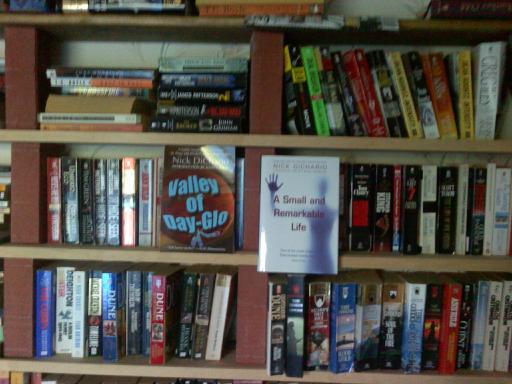
I can't say enough good things about Robert J. Sawyer. We've been great pals for nearly 20 years, and he published my first two novels under his Robert J. Sawyer Books imprint: A Small and Remarkable Life (2006) and Valley of Day-Glo (2008).
Both novels, which might have otherwise gone unpublished, were nominated for the John W. Campbell Memorial Award for Best SF Novel of the Year.When I was in college, I was lucky enough to study under two wonderful teachers and brilliant writers, Anne Coon and Abraham Rothberg. The three of us are still connected and see each other when we can. I guess the upshot is that writing doesn't have to be as lonely as it's made out to be. Writers and their mentors develop special bonds because of the passion and intensity of the insurmountable task they share: to create something that other people want to read.
As any honest existentialist should, you authentically accepted responsibility for life choices, quit teaching last year and took the challenge to continually create yourself—and, yippee, there’s a third novel. Genre? Favorite character? Blurb? Any release date yet?
Ah, so you noticed my penchant for existentialism. I think it's a fine philosophy that knows no bounds and gets deeper the more you explore it. I guess some of that has escaped into my first two novels. I've written a few book and film reviews for Philosophy Now Magazine through the existential microscope. I don't claim to be an expert, and I've thought on more than one occasion that a little knowledge can be a dangerous thing.
No more so, I suspect, than with my third novel, which I've just completed. This one might be more existential than the previous two. I'm not sure how you would categorize the book. Mystery maybe, or somewhere in the speculative/mystery/suspense family. It's nothing like my first two books, which are nothing like each other. As usual, my work remains difficult to categorize. No publisher or publication date yet, but I hope that happens some day soon so you can all read it!
Me too! I can’t wait to see what book three brings. I’m a big fan of Danny Rose, and an even bigger fan of Tink Puddah. To quote Chadwick Ginter’s review:
 ‘Tink Puddah is an orphan, struggling to survive in the Adirondack Mountains of 1845. But Tink is also a blue skinned alien from Wetspace. In Nick DiChario’s debut novel from Robert J Sawyer Books, we are seeing what author Nancy Kress has called "one of the most original first-contact novels ever."
To the residents of Skanoh Valley, Tink Puddah is just another foreigner. An odd, and gentle man who has touched many lives. But to preacher Jacob Piersol, the atheist Puddah represents both a challenge and a trial. One that could cause the preacher to lose his own soul as he struggles to save the alien’s. Deftly told in two timeframes, from Puddah's orphaning, and immediately following his death, DiChario has crafted a beautiful novel, whose symmetry and balance will leave you questioning just what it means to be human.’The way you’ve handled writing from an alien PoV, transcending reader’s disbelief, is an inspiration to writers of all genres. Then, book two shows just how imaginative and subtly twisted with satirical humor you are, Nick. Paul DeFlippo of Asimov’s Science Fiction magazine had this to say:
 ‘Once upon a future time, there was a brave and resourceful—albeit cripplingly asexual—Native American lad named Broadway Danny Rose, son of Who’s Afraid of Virginia Woolf ? and The Outlaw Josey Wales.
Confused? Let’s start again. Nick DiChario has written a new bonkers novel, Valley of Day-Glo (Robert J. Sawyer Books, trade paper, $15.95, 240 pages, ISBN 978-0-88995-415-1), which channels the proud and seminal shades of Robert Sheckley and George Alec Effinger into a vivid and unique tale of some outrageous and bizarre post-apocalypse doings involving a handful of hapless survivors.
The backstory is this: sometime a couple of centuries from our era the planet has undergone the Reddening, a disastrous collapse that left the environment stripped and barren. Indians are the only group who have managed to remain extant on the North American continent, and they have done that only by plundering the buried remnants of the earlier civilization. Taking their personal names from movie titles, revering such tomes as The Microwave Cookbook and The Modern Book of Baseball, they live spartan lives interspersed with deadly internecine rumbles. One legend, however, remains a common inspiration: that somewhere exists the Valley of Day-Glo, a utopian earthly paradise. DiChario’s dry wit and antic imagination, propels this weird odyssey at an unflagging pace, and carries the reader effortlessly along.’
 As a lover of stories that transcend the norm, I think everyone should grab these up if they haven't already. And, Nick, you're not only a renowned author, with your impressive teaching career you’ve inspired all levels of writers including myself. What would you say are the biggest mistakes authors make? Any thoughts on hunting an agent or sending direct to publishers? Is there a predominate piece of advice you’d offer an aspiring author?
 Nick DiChario’ short stories have appeared in many magazines and anthologies including The Year’s Best Science Fiction, The Year’s Best Fantasy and Horror, and The Best Alternate History Stories of the 20th Century. Nominated for two Hugo Awards and a World Fantasy Award, the list of credentials is quite long, so please check out his website at http://www.nickdichario.com/ for the fuller picture.
http://nickydthewriter.wordpress.com/
What were your early influences in writing? Any mentor you wish to mention?
When I started writing science fiction way back in the 1980s, I took a writers' workshop at SUNY Brockport with SF author Nancy Kress. Thus began a long friendship that has lasted to this day. Mike Resnick was also a big help to me in my career. We collaborated on a bunch of stories and even published a collection of our short fiction titled Magic Feathers.
I can't say enough good things about Robert J. Sawyer. We've been great pals for nearly 20 years, and he published my first two novels under his Robert J. Sawyer Books imprint: A Small and Remarkable Life (2006) and Valley of Day-Glo (2008).
Both novels, which might have otherwise gone unpublished, were nominated for the John W. Campbell Memorial Award for Best SF Novel of the Year.When I was in college, I was lucky enough to study under two wonderful teachers and brilliant writers, Anne Coon and Abraham Rothberg. The three of us are still connected and see each other when we can. I guess the upshot is that writing doesn't have to be as lonely as it's made out to be. Writers and their mentors develop special bonds because of the passion and intensity of the insurmountable task they share: to create something that other people want to read.
As any honest existentialist should, you authentically accepted responsibility for life choices, quit teaching last year and took the challenge to continually create yourself—and, yippee, there’s a third novel. Genre? Favorite character? Blurb? Any release date yet?
Ah, so you noticed my penchant for existentialism. I think it's a fine philosophy that knows no bounds and gets deeper the more you explore it. I guess some of that has escaped into my first two novels. I've written a few book and film reviews for Philosophy Now Magazine through the existential microscope. I don't claim to be an expert, and I've thought on more than one occasion that a little knowledge can be a dangerous thing.
No more so, I suspect, than with my third novel, which I've just completed. This one might be more existential than the previous two. I'm not sure how you would categorize the book. Mystery maybe, or somewhere in the speculative/mystery/suspense family. It's nothing like my first two books, which are nothing like each other. As usual, my work remains difficult to categorize. No publisher or publication date yet, but I hope that happens some day soon so you can all read it!
 ‘Tink Puddah is an orphan, struggling to survive in the Adirondack Mountains of 1845. But Tink is also a blue skinned alien from Wetspace. In Nick DiChario’s debut novel from Robert J Sawyer Books, we are seeing what author Nancy Kress has called "one of the most original first-contact novels ever."
To the residents of Skanoh Valley, Tink Puddah is just another foreigner. An odd, and gentle man who has touched many lives. But to preacher Jacob Piersol, the atheist Puddah represents both a challenge and a trial. One that could cause the preacher to lose his own soul as he struggles to save the alien’s. Deftly told in two timeframes, from Puddah's orphaning, and immediately following his death, DiChario has crafted a beautiful novel, whose symmetry and balance will leave you questioning just what it means to be human.’The way you’ve handled writing from an alien PoV, transcending reader’s disbelief, is an inspiration to writers of all genres. Then, book two shows just how imaginative and subtly twisted with satirical humor you are, Nick. Paul DeFlippo of Asimov’s Science Fiction magazine had this to say:
 ‘Once upon a future time, there was a brave and resourceful—albeit cripplingly asexual—Native American lad named Broadway Danny Rose, son of Who’s Afraid of Virginia Woolf ? and The Outlaw Josey Wales.
Confused? Let’s start again. Nick DiChario has written a new bonkers novel, Valley of Day-Glo (Robert J. Sawyer Books, trade paper, $15.95, 240 pages, ISBN 978-0-88995-415-1), which channels the proud and seminal shades of Robert Sheckley and George Alec Effinger into a vivid and unique tale of some outrageous and bizarre post-apocalypse doings involving a handful of hapless survivors.
The backstory is this: sometime a couple of centuries from our era the planet has undergone the Reddening, a disastrous collapse that left the environment stripped and barren. Indians are the only group who have managed to remain extant on the North American continent, and they have done that only by plundering the buried remnants of the earlier civilization. Taking their personal names from movie titles, revering such tomes as The Microwave Cookbook and The Modern Book of Baseball, they live spartan lives interspersed with deadly internecine rumbles. One legend, however, remains a common inspiration: that somewhere exists the Valley of Day-Glo, a utopian earthly paradise. DiChario’s dry wit and antic imagination, propels this weird odyssey at an unflagging pace, and carries the reader effortlessly along.’
 As a lover of stories that transcend the norm, I think everyone should grab these up if they haven't already. And, Nick, you're not only a renowned author, with your impressive teaching career you’ve inspired all levels of writers including myself. What would you say are the biggest mistakes authors make? Any thoughts on hunting an agent or sending direct to publishers? Is there a predominate piece of advice you’d offer an aspiring author?
Writers just starting out make all kinds of mistakes, but I don't think that's necessarily a bad thing. Nothing teaches us quicker than our mistakes. (Take my word for it.) Instead of trying to avoid them, we should probably embrace them, learn from them, and move on. I will add, though, because I think it's true for everyone: You simply cannot give up on your dream. Lance Armstrong once said, "Pain is temporary. Quitting is forever."
Writing is hard work, but if you think it hurts to go on, think about how much it will hurt to stop. A nearly insignificant percent of one percent of all published authors are natural talents who didn't have to work for years at it before being successful. I don't know why that comes as such a surprise to most new writers, or why it seems to discourage them.
It takes an incredible amount of guts to keep writing through the learning stages and the rejections and the disappointments, but they're all just battles. You only lose the war when you give up on yourself. Whether you're just beginning, or hunting for an agent, or submitting to editors, there's only one rule that matters: Don't give up.
Where do you think the sci-fi genre is headed? Thoughts on whether TV influences sci-fi writers or vice versa?
I'm an eternal optimist, so I hope that the sci fi fiction genre will hit another upswing eventually. It's been in a dark valley for a long time. Readership is down, and many of its best magazines have ceased publication. But sf on the big and little screens seems to be doing okay. Avatar is now the most successful film of all time.
Rob Sawyer's excellent novel FlashForward has been made into a compelling TV series on ABC. And if you throw fantasy, graphic novels, and comic books into the mix, undoubtedly second cousins to sf, there is plenty of evidence that people are still fascinated by it. The trick is getting people interested in reading the good stuff, not just grabbing the media tie-ins or film novelizations.
I think most readers really do want to stretch their minds and enjoy the best that any genre has to offer, but sometimes it's hard to identify and find those books. I don't know if there is a magic bullet that can make that happen, but I do know that sf film and literature are now, and probably forever, married for better or worse.
Why or why not e-books? Do you own, or plan to, a kindle or ipad?
Well, there's no doubt that e-books will be a part of the publishing landscape for years to come. It's only in its infancy now. I'm really looking forward to where it goes from here. I don't have an e-reader yet, but I suspect it's inevitable. I'm waiting for one that really calls out to me. The iPad doesn't have a reader-friendly screen, and what I've seen of the other readers makes me think they can be vastly improved. I'm also a big fan of audio books, so I guess I don't feel the same sense of urgency that others seem to feel for e-readers. And, well, I grew up with books, and I still haven't found a better reading device.
Thank you, very much, for spending some time with us, Nick. I plan to announce book three as soon as it hits the shelves, and without a doubt there's many fans anticipating whatever’s percolating in your mind/heart right now.
Writing is hard work, but if you think it hurts to go on, think about how much it will hurt to stop. A nearly insignificant percent of one percent of all published authors are natural talents who didn't have to work for years at it before being successful. I don't know why that comes as such a surprise to most new writers, or why it seems to discourage them.
It takes an incredible amount of guts to keep writing through the learning stages and the rejections and the disappointments, but they're all just battles. You only lose the war when you give up on yourself. Whether you're just beginning, or hunting for an agent, or submitting to editors, there's only one rule that matters: Don't give up.
Where do you think the sci-fi genre is headed? Thoughts on whether TV influences sci-fi writers or vice versa?
I'm an eternal optimist, so I hope that the sci fi fiction genre will hit another upswing eventually. It's been in a dark valley for a long time. Readership is down, and many of its best magazines have ceased publication. But sf on the big and little screens seems to be doing okay. Avatar is now the most successful film of all time.
Rob Sawyer's excellent novel FlashForward has been made into a compelling TV series on ABC. And if you throw fantasy, graphic novels, and comic books into the mix, undoubtedly second cousins to sf, there is plenty of evidence that people are still fascinated by it. The trick is getting people interested in reading the good stuff, not just grabbing the media tie-ins or film novelizations.
I think most readers really do want to stretch their minds and enjoy the best that any genre has to offer, but sometimes it's hard to identify and find those books. I don't know if there is a magic bullet that can make that happen, but I do know that sf film and literature are now, and probably forever, married for better or worse.
Why or why not e-books? Do you own, or plan to, a kindle or ipad?
Well, there's no doubt that e-books will be a part of the publishing landscape for years to come. It's only in its infancy now. I'm really looking forward to where it goes from here. I don't have an e-reader yet, but I suspect it's inevitable. I'm waiting for one that really calls out to me. The iPad doesn't have a reader-friendly screen, and what I've seen of the other readers makes me think they can be vastly improved. I'm also a big fan of audio books, so I guess I don't feel the same sense of urgency that others seem to feel for e-readers. And, well, I grew up with books, and I still haven't found a better reading device.
Thank you, very much, for spending some time with us, Nick. I plan to announce book three as soon as it hits the shelves, and without a doubt there's many fans anticipating whatever’s percolating in your mind/heart right now.


