Tuesday, April 5, 2016

Five #Author Shortcuts To Save Time #marketing

Hi, I'm Pippa Jay, author of scifi and supernatural stories to engage the emotions. Today I wanted to share five things I use to save me precious time when it comes to promoting, so I can get back to the actual job of writing. I hope they might help you too! If you know of any others, please share them in the comments. (These are all services I use and personally recommend, but there are others available).
  1. Booklinker.net - this gives you a shortened universal Amazon URL that will take anyone who clicks it to the appropriate Amazon store for their location. So no more having to tweet/post individual links for the UK, Canada, Australia etc. You can also create one for your Amazon author page. However, I'd recommend using it only for your own individual books - once a book URL is registered with the site, no one else can use it which might be an issue with multi-author anthologies or boxed sets for example. For those you might need permission, or to nominate one author to take responsibility for it. If you're with a publisher, you might also need their permission.
  2. Bitly.com to shorten links - There are lots of sites that will do this, but I find this one is the best. My embedded eBook links don't like the URLs from my website because of the # in page URL, but bitly not only shortens lengthy URLs but removes this issue. Why shorten links? Well, it gives you more character space in tweets if you're not using something like Hootsuite for example (more on that further down). And it looks less untidy in your social media links if you're not embedding them or inserting hyperlinks. It can also tell you how many clicks a particular link gets, so if you wanted to track a particular marketing method or promo event, you can assign separate bitly links and check the stats.
  3. Link your Facebook page to Twitter - Go to www.facebook.com/twitter. It gives you the option to add any pages you admin and your profile, so choose whichever you wish. This means whenever you post to your page, it gets tweeted too, saving you a job. It might also help with your page visibility. One note of warning: If you use the scheduling function on your page, it won't tweet that scheduled post. Don't ask me why. I've tried asking and complaining and got zero help from Facebook. But there's a way around it...
  4. Link your blog to Twitter - I use twitterfeed.com but there are others. So when a new blog post goes live, it automatically tweets (though there can be a delay up to a couple of hours. Again, I don't know why). You can also add hashtags to be included in the blog tweet, but bear in mind it'll be added to EVERY blog post tweet, so be sure to use something that will apply to anything you post. You can also link your blog to your Amazon page (via Author Central), and your Goodreads account.
  5. Hootsuite - this allows you to not only schedule tweets but also to other social media platforms. The free version allows for three social media sites - I use it to post to my Facebook fanpage (this gets around the issue of posts scheduled on your actual page not tweeting), Twitter, and my Facebook group. You can add more with the paid version. This means you can space out promo to stop it being annoying, and schedule for days when you're away from social media (for those who can escape the time suck!). You can also set up streams to follow certain accounts, hashtags etc (a bit like Twitter lists but you can see several on a page - handy for events).WARNING: When converting Amazon links, be sure to delete unwanted extra text from your URL. A direct Amazon link should look like this - http://www.amazon.com/gp/product/B01BI7BDC2 And NOT like this - http://www.amazon.com/Quickshot-Pippa-Jay-ebook/dp/B01BI7BDC2/ref=sr_1_1?s=digital-text&ie=UTF8&qid=1459241496&sr=1-1&keywords=quickshot You don't need any of the text from and including ref. There was an article about this HERE. 
I hope you find some of these useful, and please share any you've found.
Disclaimer: Any views expressed in the post are purely the opinion of the author and not the SFR Brigade.

Bio: 
After spending twelve years working as an Analytical Chemist in a Metals and Minerals laboratory, Pippa Jay is now a stay-at-home mum who writes scifi and the supernatural. Somewhere along the way a touch of romance crept into her work and refused to leave. In between torturing her plethora of characters, she spends the odd free moment playing guitar very badly, punishing herself with freestyle street dance, and studying the Dark Side of the Force. Although happily settled in the historical town of Colchester in the UK with her husband of 22 years and three little monsters, she continues to roam the rest of the Universe in her head.

Pippa Jay is a dedicated member of the Science Fiction Romance Brigade, Broad Universe, and EPIC,  blogging at Spacefreighters Lounge, Adventures in Scifi, and Romancing the Genres. Her works include YA and adult stories crossing a multitude of subgenres from scifi to the paranormal, often with romance, and she’s one of eight authors included in a science fiction romance anthology—Tales from the SFR Brigade. She’s also a double SFR Galaxy Award winner, been a finalist in the Heart of Denver RWA Aspen Gold Contest (3rd place), the 2015 EPIC eBook awards, the 2015 RWA LERA Rebecca (2nd place), and the GCC RWA Silken Sands Star Awards (2nd place).

You can stalk her at her website, or at her blog, but without doubt her favorite place to hang around and chat is on Twitter as @pippajaygreen.


A Space Opera Short Story
Goodreads | Webpage
Amazon | ARe | 
Smashwords
iTunes | Kobo | B&N
Blurb:
Sal, a legal carrier (just about) of whatever comes her way, puts her trust in just two things: her guns.

Keeping out from under Imperium eyes—especially those belonging to a certain Ehi Wahu—while making a living, and trying to keep a lover who can tolerate her twitchy trigger fingers, are the extent of her ambitions.

Then a kiss from a passing stranger, and a promise of the biggest score in a long time, tempt her. Devin fulfils more than one need, but he comes with more trouble than one woman can handle. And this time it'll take more than her guns to save her. She'll have to trust a man again.

WARNING: for over 18s only. Adult content including sex, bad language, & implied extreme violence.


Thursday, March 24, 2016

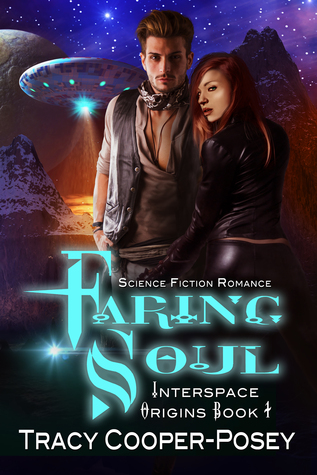
SFRB Recommends #54: Faring Soul by Tracy Cooper-Posey #scifi #romance #sfrom


Rumors emerge that Catherine Shahrazad, possibly the oldest person in the galaxy, has returned from the fringes and has been seen in Federation space. Wherever she goes, her name and her history cause civil unrest, riots and worse. The Federation Board doesn’t want her there.  Neither do the leaders of Cadfael College, the educators and moralists of the galaxy. No one pays any attention to the reticent navigator called Bedivere X, who pilots her ship better than she does.
The truth about Bedivere threatens the entire Federation.
His feelings for Cat might just save everyone.


"Je pense, donc je suis." -René Descartes
 
One of my favorite aspects of science fiction is the questions it makes us ask about ourselves and society. Faring Soul intertwines questions with the romance. What does it mean to love another, and what does that do for our identities? Is love what makes families, societies, religions? I enjoy when a book makes me think about these possibilities and how their underlying principles may apply to us today.

Cooper-Posey explores love and consciousness (not to mention aging, parenting, and bigotry) with enigmatic and interesting characters: they are questing for answers as much as I am. Their questions are different because they have been shaped by societies very different from my own. Catherine's mission during the story may seem like a small favor against a big backdrop, but its repercussions will send ripples through states, churches, and corporations across the universe.

Catherine and Bedivere get a Happy For Now, as Faring Soul is first in a series called Interspace Origins. Their story will be continued in Varkan's Rise and Cat and Company.

Author site: Tracy Cooper-Posey

Recommendation by Lee Koven.

Wednesday, March 23, 2016

Historical Research for the Science-Fiction Writer

by S.M. Schmitz


When I was still teaching world history, each semester I required my students to conduct original research on a topic of their choice for a short paper. For most of my students, this was the first time they had to locate a primary source or track down a reliable secondary source by a professional in an academic field related to their thesis topic (e.g., historian, sociologist, anthropologist).

Each semester, students asked me how they were supposed to get started on their research. In an age where college students have grown up accessing information and misinformation from the Internet, my forbidding them from using websites for their secondary source proved particularly challenging for them.

As a result, I developed a fairly easy way for my students to begin their journeys as amateur historians. Given that science-fiction and fantasy writers often use history and mythology to build their fictional worlds, this introduction to conducting historical research may be beneficial to my fellow authors as well.

In order to illustrate how we will conduct our beginner’s-guide-to-historical-research, I’ll use an example from the Classical world. Greek history and mythology holds a particular appeal to writers of all genres, so we’ll build our fictional world around the culture of the Spartans.

As an initial caveat, all of this advice supposes that your subject matter is at least somewhat well-known and established as a matter of historical interest.

1.      Love it or hate it, Amazon offers the widest selection of online books I’ve found, so using their search engine will return numerous sources that we can begin to plow through.

I entered “Spartan culture” as my search term, which produced 375 titles in books. The top two choices are The Spartans: The World of the Warrior-Heroes of Ancient Greece by Paul Cartledge and Spartans: a New History by Nigel M. Kennell.

First: check the publication date. Books published over twenty years ago may be outdated as newer research can and often does change the way historians think and write about a particular subject. Both of our books are recent.

Second: click on the author’s name. Paul Cartledge’s author page tells me he is a professor of Greek culture at Cambridge. That’s a good sign. Let’s Google him.

a.       Why? Because having a PhD and working at a university – even a distinguished one – doesn’t make a particular person or book a reputable authority nor does it make their research and book a reliable source of information. Example: Daniel Jonah Goldhagen’s Hitler’s Willing Executioners earned him widespread criticism from the historical community, yet it became a New York Times bestseller. Unfortunately, people outside of the profession had no way of knowing the numerous problems associated with Goldhagen’s thesis and research.
b.      A Google search of Paul Cartledge doesn’t reveal any notable criticisms.
c.       Using your public library’s database (in the U.S.), you can now access numerous scholarly (peer reviewed) articles. Search for the particular book and author and see how the historical community received this work. My search yielded peer reviews that are favorable, and highlight a particular issue with primary sources we’ll address below.

2.      We now have a good secondary source that we can begin reading to understand the world of the Spartans. It’s a good idea to repeat the above process to find several secondary sources, and always resist the temptation to use a website for your information (there are exceptions – particularly in the case of accessing primary sources).

3.      Primary sources are those sources that offer us firsthand accounts of a particular event or otherwise provide contemporary information from the time period. Examples are journal entries, court records, wills and other legal documents, plays and poems, etc.

How necessary is it for a science-fiction author to access and interpret primary sources? In my opinion, not very. In fact, it may do more harm than good. In our example, the Spartans have very few primary sources written from their perspective: much of what we know about them comes from the Athenians, and historians have to be careful when interpreting those sources as there is an obvious bias (the Spartans and Athenians were constant rivals).

If you would like to read some primary sources from your chosen culture, check the bibliography of the secondary sources you’ve selected. Historians will list the primary sources they’ve used in their own research and this is the easiest way to find sources for your own subject. Older writings that are not copyrighted are frequently available on university websites. In the case of the Spartans, we can find Herodotus’s and Plutarch’s accounts of the Battle of Thermopylae from numerous universities. Since the translation of primary sources is an important factor in their reliability, it’s a good idea to stick to university or library websites.

Why is it so important to research the influence of our fictional worlds before using it in our novels?

Because there are plenty of readers who will notice the similarities, and if they notice the source of the influence, they will most likely know whether or not we portrayed our fictional world in a way that is based on actual history or popular misconceptions about that history. Using history and mythology can be interesting ways for the science-fiction writer to offer social commentary or just draw parallels from an imaginary world to our own. And now that you have a basic guide to getting started on historical research for the science-fiction writer, I hope that you’ll be inspired to draw on our past experiences and beliefs for your next novel.

© S.M. Schmitz, 2016. All Rights Reserved.


Author Bio:

S.M. Schmitz has an M.A. in modern European history and is a retired world history instructor. Her novels are infused with the same humorous sarcasm that she employed frequently in the classroom. As a native of Louisiana, she sets many of her scenes here, and like Dietrich in her Resurrected trilogy, she is also convinced Louisiana has been cursed with mosquitoes much like Biblical Egypt with its locusts.

Her prior novels include the Resurrected trilogy, which are science-fiction romances, The Immortals series, which are heavily influenced by Middle Eastern mythology and world history, The Golden Eagle, a dystopian romantic suspense, and Dreamwalkers, a paranormal psychological suspense. 

To learn more, please visit www.smschmitz.com.


To connect with the author on social media, you can follow her on Facebook at Author S. M. Schmitz or on Twitter.

If you’d like to get a free e-copy of Resurrected just for signing up for her mailing list, you can claim it here.


Peyton’s Myth, Book 1 of The Cambria Code series

When a mysterious spaceship appears above Cambria, Zoe remains skeptical that it’s anything but an elaborate hoax. By the time the first spaceship is joined by two others, Zoe reluctantly admits that Earth has been invaded, even though it’s a pretty lame invasion: the aliens look remarkably human and keep to themselves. From what humans are able to learn about them, they seem incredibly arrogant and boring anyway.

After meeting Peyton, one of Earth’s newest residents, Zoe feels an immediate attraction to him although she is reluctant to become involved with someone who isn’t even human. But she soon discovers that these aliens are far more dangerous than they’ve led everyone to believe, and the secrets they are hiding may signal the destruction of her entire planet.


Thursday, March 10, 2016

SFRB Recommends #53: Riveted by Meljean Brook #steampunk #romance #sfr

A century after a devastating volcanic eruption forced Iceland’s inhabitants to abandon its shores, the island has become enshrouded in legend. Fishermen tell tales of giant trolls guarding the land and of seductive witches who steal men’s hearts. But the truth behind the legends is mechanical, not magic—and the mystery of the island a matter of life and death for a community of women who once spilled noble blood to secure their freedom.

Five years ago, Annika unwittingly endangered that secret, but her sister Källa took the blame and was exiled. Now Annika serves on the airship Phatéon, flying from port to port in search of her sister and longing to return home...but that home is threatened when expedition leader David Kentewess comes aboard.

Determined to solve the mystery of his own origin, David will stop at nothing to expose Annika’s secrets. But when disaster strikes, leaving David and Annika stranded on a glacier and pursued by a madman, their very survival depends on keeping the heat rising between them—and generating lots of steam...


The world of the Iron Seas is original and fully realized. David and Annika are, as well: she's a woman of color from Iceland (yes, there's a reason) with great mechanical acumen, and he's a cyborg (due to an accident) who chases volcanoes. Their missions collide aboard an airship, and they find they have an intense chemistry and friendship that develops organically. Although Annika may want to help David for personal reasons, she cannot endanger her people further.

Riveted is a finely crafted story with tight plotting, convincing action, and memorable characters that made its way onto my keeper shelf years ago. It touches my heart every time I reread it.

Author site: Meljean Brook - Author

Recommendation by Lee Koven.

SFR Brigade Bases of Operation